

7.1×
Revenue Growth
Aug 2022 → 2025
38,459
New Customers in 2025
vs. 5,493 in 2022
11×
Subscriber Growth
1,300 → 14,500 active
$8.85M
2025 Revenue
from sub-$100K/month
01 The Situation
Skinesa is a skin probiotic. It works, not in the aspirational sense that most supplement marketing implies, but in the clinical sense that matters: it addresses the gut-skin axis, and it resolves chronic skin conditions, including eczema and psoriasis, in more than nine out of ten cases. Patients who have spent years on topical steroids, treatments with documented long-term side effects, find relief. The product is not a cosmetic solution. It is a health intervention.
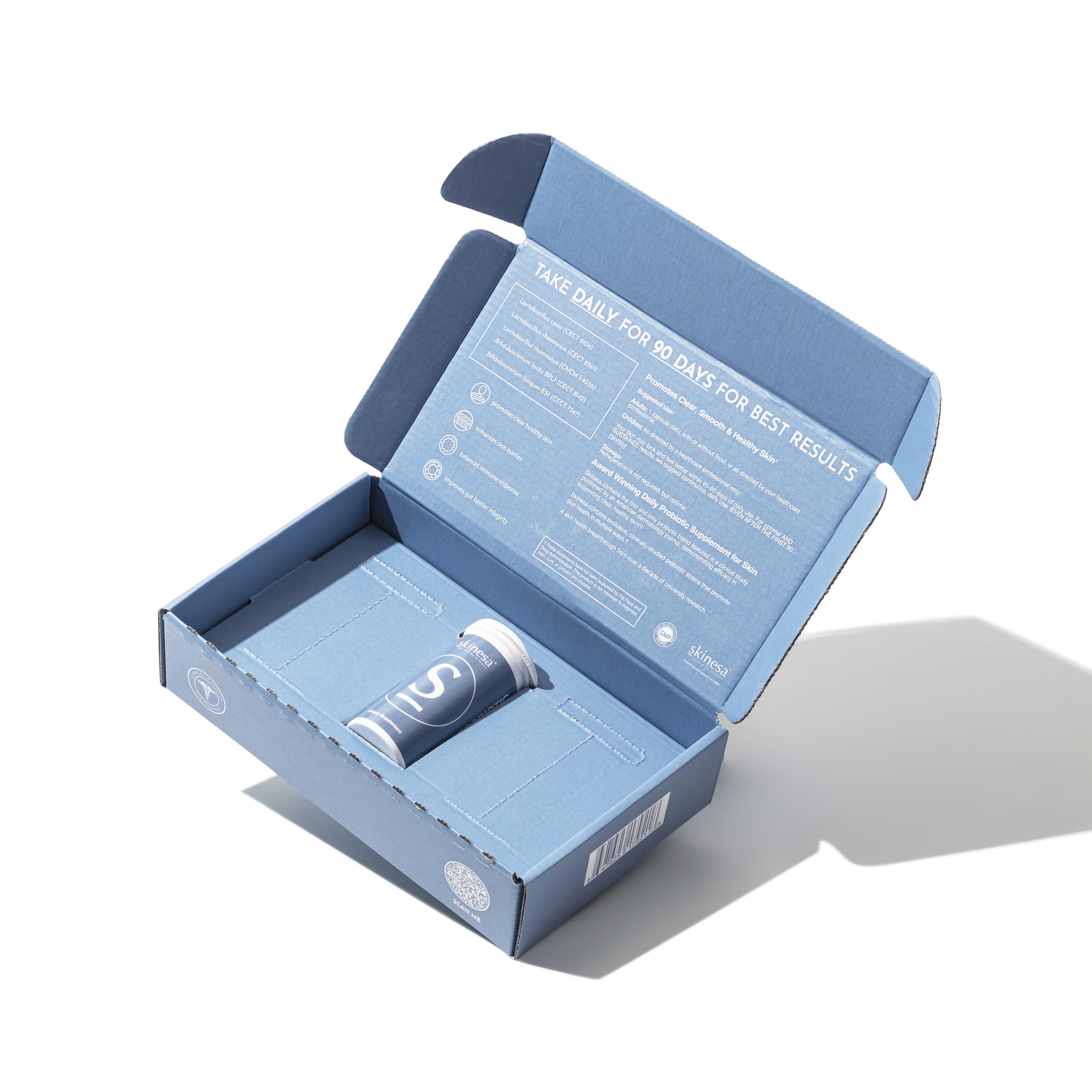

The problem is that none of that can be said in an advertisement.
Under FTC and FDA guidelines governing health supplement advertising, you cannot name a disease. You cannot reference a condition. You cannot draw a direct line between a product and the medical outcome it consistently produces. The language that would make Skinesa immediately obvious to the people who need it most, people with eczema, people with psoriasis, people who have been failed by conventional medicine, is precisely the language that is legally forbidden.
This was the environment in which the engagement began in August 2022. Skinesa was generating less than $100,000 in monthly revenue. It had a single product, 1,300 active subscribers, and a Facebook advertising account operating without a coherent model of customer lifetime value. The first-purchase economics were structurally negative in a way that made scaling feel irresponsible. And the most powerful selling proposition in the brand's arsenal could not be spoken aloud.
The Market
Skinesa did not enter an established category. There was no segment called 'skin probiotics' with existing consumer awareness or competitive benchmarks. The brand was not competing against other probiotics for a customer who had already decided to buy one. It was competing against a worldview, the quiet, exhausted belief, held by millions of people living with chronic skin conditions, that nothing would ever truly work.
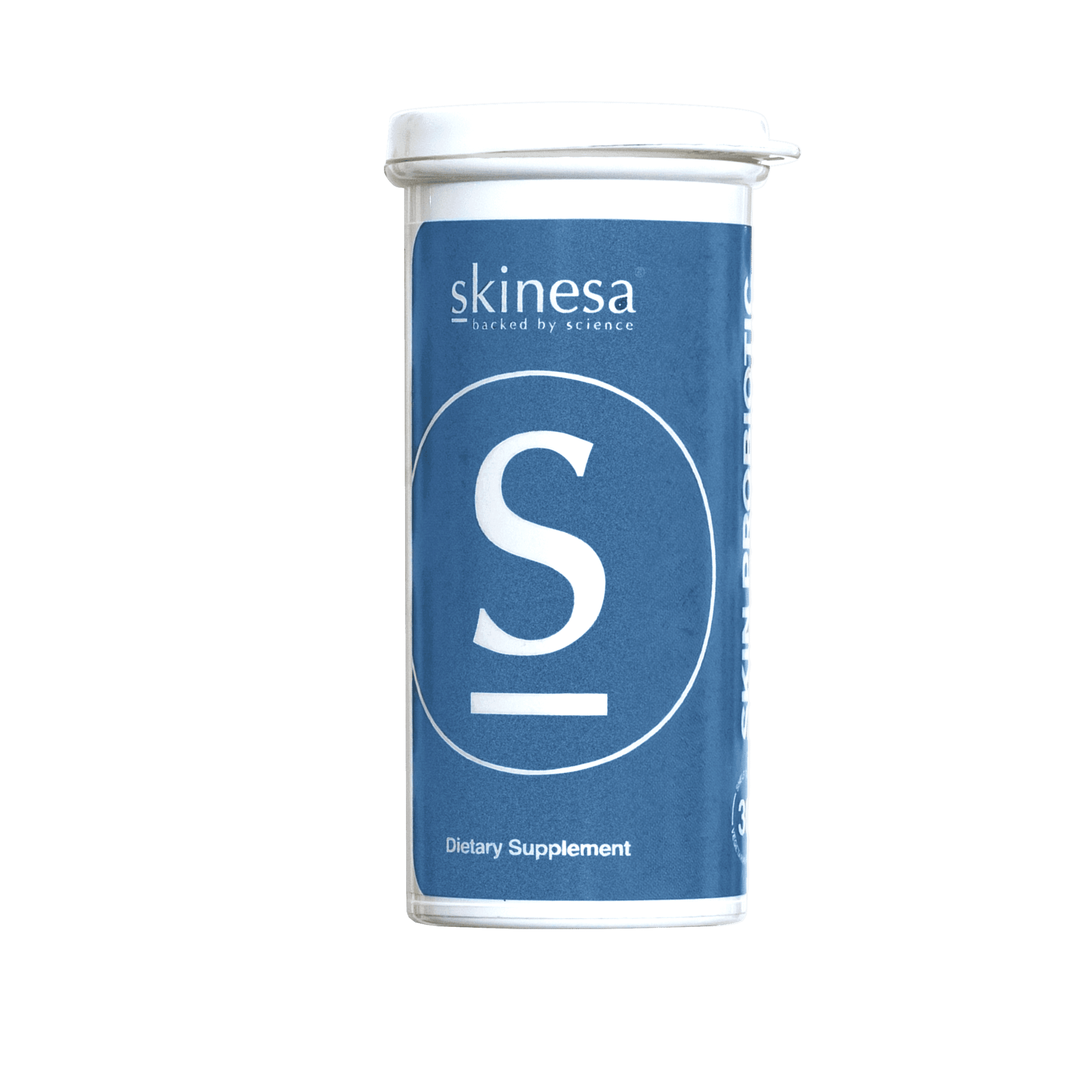
The real alternative to Skinesa was not another supplement. It was a lifetime prescription for corticosteroids, a treatment that manages symptoms, causes long-term side effects, and creates dependency. The brand's positioning challenge was not differentiation. It was the replacement of medical resignation with a credible alternative.
The Constraints
Every strategic and operational decision made across three and a half years was shaped by a compounding set of real constraints, not hypothetical ones.
Regulatory
No disease claims. No condition-specific language. No references to eczema, psoriasis, or any named dermatological condition in any advertising material, at any funnel stage, on any platform.
Financial
All growth was cashflowed on 30-day net terms against a 60-day production cycle. Every scaling decision had to be absorbable within the cash the business actually had. The founders could not simply outspend a problem.
Platform
The engagement began in the direct aftermath of Apple's iOS 14.5 changes, which dismantled Meta attribution infrastructure across the industry. Health and wellness advertisers faced additional platform-level scrutiny. CPMs were rising during the sharpest US inflation environment in a generation.
Channel
In late 2023, fraudulent competitors flooded Amazon with counterfeit Skinesa listings. Negative reviews from products that were not Skinesa accumulated on Skinesa's legitimate pages. The decision was made to exit Amazon entirely. From 2024 onward, every dollar of revenue was generated through owned and paid channels, with zero marketplace contribution.
02 The Challenge
The mandate from Skinesa's founders had three parts, in practice if not in words: grow revenue significantly, do not grow faster than the cash can support, and keep new customer acquisition cost as low as possible.
That third requirement was the one that needed to change.
The founders, as is rational for any business operating on tight cashflow, had anchored on low NCPA as the primary measure of acquisition performance. In a constrained environment, every new customer acquired above a certain cost threshold felt like a loss the business was absorbing. What had not been modeled, at the start of the engagement, was what that customer was actually worth. The relationship between first-purchase cost, subscription conversion, and lifetime value had never been built into a number that could drive decision-making.
Until it was, there was no principled basis for scaling aggressively. And without that basis, the brand would continue to grow, slowly, cautiously, and far beneath its potential.
The challenge was therefore not simply a creative or media problem. It was a reframing of what performance advertising meant for this specific brand, followed by the construction of a growth system that could operate within genuine financial constraints while scaling at a pace the founders had not believed was achievable.
03 The Strategic Insight
Two insights, taken together, unlocked everything that followed.
The first was about time. Skinesa's subscription model meant that a new customer's value was not determined by what they spent on their first order. It was determined by what they spent over the following months, and the data showed that subscribers ordered an average of 4.5 times over their lifetime, with the most loyal customers returning more than 50 times. Once this was modeled with discipline, the entire CPA conversation changed. A first-purchase acquisition cost that appeared unacceptable in isolation was entirely rational in context. The constraint was not NCPA. The constraint was cashflow, specifically, how much the business could front before the subscription revenue cycle returned the capital. The sustainable scaling ceiling was approximately 50% of trailing revenue in advertising spend. Within that ceiling, aggressive growth was not only possible, it was correct.
The second insight was about the restriction itself. The prohibition on disease claims was not, as it first appeared, a ceiling on what the advertising could accomplish. It was a specification for how to accomplish it differently. If you cannot describe the outcome, you must describe the experience of living without it. You must make the audience feel recognized, their years of failed treatments, their distrust of the medical system, their quiet desperation before you present a solution. This is a more durable form of persuasion than claim-based advertising. It creates belief, not just purchase intent. And belief, in a category built on skepticism, is the only currency that compounds.
04 The Approach
The media architecture was deliberately simple: own the top of the funnel. Video-first, education-led creative did the work of awareness and belief-building. A small set of high-performing static assets served as rational closers, the final content a considered buyer encountered before converting. Acquisition was the engine. Retention was a coordinated but separate system. Ninety percent of effort went to finding new customers. The business required it.
New customers were not just a metric. They were the mechanism. Skinesa's subscription base could only grow if new people, who had never heard of a skin probiotic, could be convinced that their chronic skin condition might have a different kind of solution, without ever being told, directly, what that solution did.
Within that structure, the creative strategy evolved through three phases. None replaced what came before. Each built on the proof that the previous phase provided.
Educate, Don't Sell
The first creative framework was built on a recognition: people with chronic skin conditions have not failed to find a solution because they haven't tried hard enough. They have failed because the solutions they were offered were the wrong ones. Steroids. Creams. Elimination diets. Dermatology appointments that ended with a prescription and no explanation.
UGC-led video content, real creators, real frustration, real stories, articulated this experience with the specificity that resonates when someone has lived it. The creative did not sell Skinesa. It validated the audience. It introduced the concept of the gut-skin axis as a biological framework, without claiming what Skinesa could do about it. The call to action was not 'buy this.' It was 'learn why nothing else has worked.'
Critically, the creative inflamed the problem before it presented the solution. Not to manipulate but because the audience's relationship with their skin was already emotionally charged, and an advertisement that didn't acknowledge that would be dismissed before it was heard.
Founder Authority
As the brand's revenue base matured and the subscription model proved its economics, the creative strategy evolved toward authority. Studio-produced content elevated production quality without sacrificing authenticity. More significantly, the founders went on camera, not to demonstrate the product, but to explain why they built it.
Founder-led content repositioned Skinesa from supplement brand to mission-driven health perspective. The narrative was not about ingredients or mechanisms. It was about the patients who had been dismissed, the treatments that caused harm, the gap in the market that existed because conventional dermatology had no financial incentive to close it. The audience was not being sold to. They were being invited into a point of view, one that happened to have a product attached to it.
The Customer as the Creative
The creative form that ultimately performed best was also the one that the regulatory framework, paradoxically, made possible: founders sitting down with real customers and asking them to tell their stories on camera.
These customers could say what the advertising could not. They could name the conditions that had resolved. They could describe the years of suffering that preceded it. They were not actors. They were not delivering scripted testimonials. They were individuals recounting their own medical histories, and because they were speaking as private citizens about their own experiences, the content operated in an entirely different register from commercial advertising.
This was the creative solution that did what the brief prohibited. Not around the restriction. Through it.
05 The Results
The Subscription Engine
1,300
Active Subscribers
Aug 2022
14,500
Active Subscribers
Feb 2026
4.5×
Avg. Orders / Subscriber
Lifetime
The subscription base is the structural proof of the strategy. 1,300 active subscribers in August 2022, a number that represented a brand with loyal early customers but no scalable acquisition system, grew to 14,500 active subscribers by early 2026. That is an 11x increase in the recurring revenue base, achieved by building a reliable pipeline of new customers who believed in the product before they bought it, and continued buying because the product delivered what the advertising could only imply.
Average subscriber lifetime encompasses 4.5 orders. The most loyal customers have placed more than 50. These are not one-time supplement buyers. They are patients who found something that worked after years of searching, and they are not inclined to stop.
New Customer Acquisition, The Engine Behind Everything
New customer acquisition was the blood of this business. Returning customers are valuable, but Skinesa's product works. When a customer's skin condition resolves, their purchase frequency naturally declines. The business could not be built on retention alone. New customers were not a growth lever. They were a survival requirement.
New customer volume grew from 5,493 in the first partial year to 38,459 in 2025, a 7x increase. The cost to acquire each new customer (NCPA) rose from $68 to $105 over the same period. This is not evidence of deteriorating performance. It is evidence of a deliberate strategic decision: to offer 90-day and 180-day supply bundles as the primary new customer entry point, increasing first-order value alongside acquisition cost. The ratio held. The business grew.
What the MER Tells Us
Marketing efficiency ratio, ad spend as a percentage of revenue, rose from 30% in 2022 to 46% in 2025. A rising MER means the brand was reinvesting an increasing share of revenue into advertising. This was a deliberate choice, made possible by the confidence the LTV model provided. When you know what a customer is worth over 4.5 orders, you can afford to spend more to acquire them. The MER rise is not a warning sign. It is the signature of a brand that understood its economics and had the conviction to act on them.
2024-2025: Growth Without Amazon
The results from 2024 and 2025 carry particular weight. Amazon, which had contributed meaningfully to earlier revenue figures, was exited entirely in late 2023 following a coordinated campaign of fraudulent competitor activity that the platform's systems were unable to contain. Every dollar of 2024 revenue ($5.75M) and 2025 revenue ($8.85M) was generated through paid and owned channels alone.
The brand did not compensate for a lost channel. It outgrew it.
2025 revenue was 7.1x the August 2022 baseline.
It was achieved under advertising restrictions, platform disruption,
record inflation, and the complete exit of a major sales channel.
These were not favorable conditions. The results are not a product of favorable conditions.
06 What This Means
For every brand owner sitting
on a product that deserves better.
The Skinesa case is not a story about a frictionless category, an unlimited budget, or a team that got lucky with a viral moment. It is a story about a product that genuinely works, and the disciplined, sustained effort required to build a growth system around it when the market, the platforms, the regulators, and the cash position all made scaling difficult.
The lessons do not belong to skincare or probiotics. They belong to any brand owner who believes their product is better than their current revenue suggests.
The constraint is the brief. The regulatory restriction placed on Skinesa's advertising was absolute and non-negotiable. It was also, ultimately, the reason the creative strategy became more sophisticated than it would otherwise have needed to be. The customer testimonial format, founders interviewing real buyers on camera, allowing them to say what the brand could not, was not a workaround. It was the best possible version of the work. Constraints do not limit great creative. They define it.
Model the lifetime before you price the acquisition. The single decision that unlocked aggressive scaling was the decision to model customer lifetime value with discipline. Once the 45-day payback cycle was understood, once the 4.5-order subscriber average was built into the acquisition math, the conversation about NCPA changed completely. A number that looked like overspending became a number that looked like investment. Most brands operating under cashflow pressure never build this model. It is the most important spreadsheet in direct-to-
consumer commerce.
New customers are not a growth lever. They are the business. Skinesa's product, when it works, solves the customer's problem. That is an extraordinary thing, and it means that retention, while valuable, has a ceiling. The brand grew because new customer acquisition was treated as the primary operational priority, year after year, regardless of how healthy the existing subscriber base looked. 38,459 new customers in 2025 did not happen by accident. They happened because the system was built specifically to produce them.